What’s happening with Crypto Markets?

Cryptocurrencies have seen a crazy week with bitcoin dipping 20% after an all-time high of $42,122 on January 8th. There is supposed to be a bullish market ahead, with altcoins to follow. Time to buy the crypto dips before they fly high! 

Why did Bitcoin dip on Monday?

Bitcoin dropped 20% since the new all-time high of $42,122 on January 8th. The violent sell-off saw record breaking trading volumes. While there is still potential for bitcoin to drop lower, a new influx of buyers will likely spark an uptrend. Alts didn’t follow with such a large drop, after a small drop of 5% they recovered overnight.

Bitcoin is attempting to bounce back after falling over 30% in the last few days. It is starting to make a recovery while other cryptocurrencies like Ether, Ripple and Litecoin are also creeping back up.

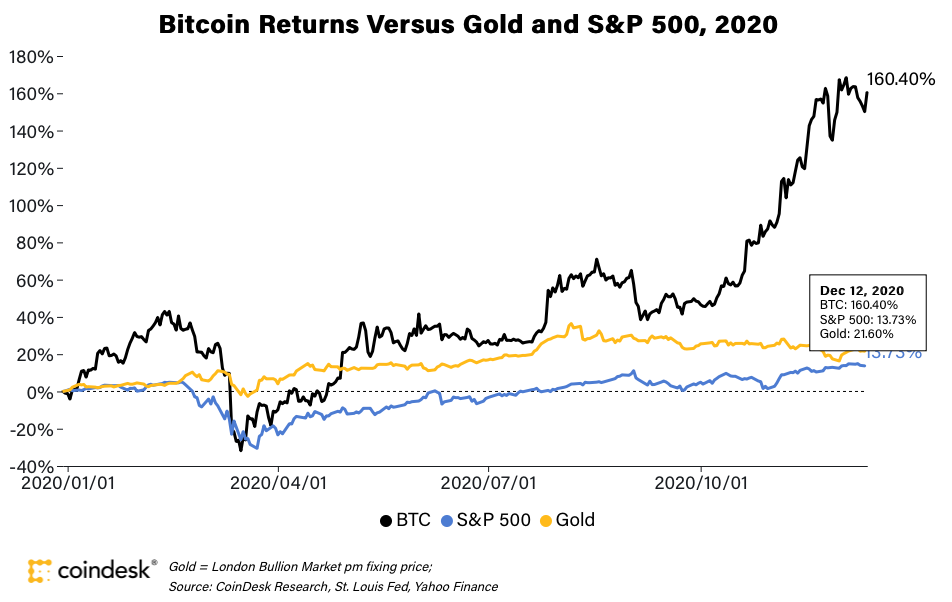
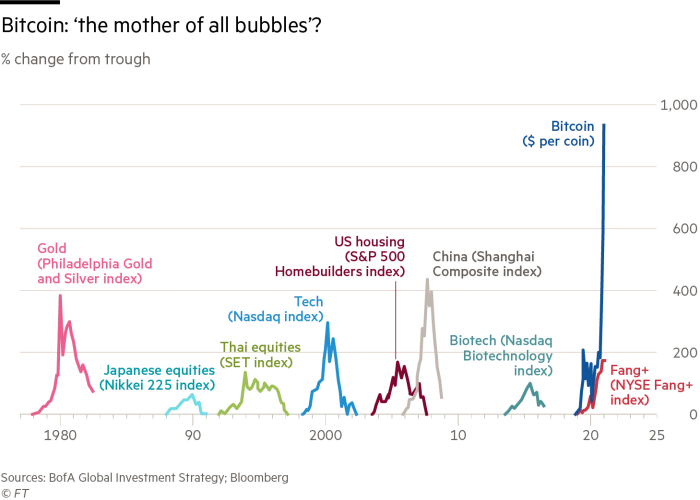
The price of Bitcoin crashed on Monday after reaching an all-time high of $42,122. Bitcoin has been growing at a phenomenal rate, seeing a 940% increase from last year’s low. This is the best performing asset in the financial market with gold only rising 25% and the S&P 500 rising 70%.

The recent volatility is likely led by the boost in popularity in cryptocurrency. The recent rally wasn’t sustainable which is why Bitcoin crashed as investors withdrew their money thinking a rise any higher without a correction would be too good to be true. 

Another reason Bitcoin has dropped is the US dollar gaining strength. The US Dollar Index rose 1.5% over the past few days sparked by the US’ political crisis and the dominance of coronavirus over Northern America and other parts of the world. The $3 trillion stimulus package that should accelerate US economic recovery has led to rising interest rates, pushing up the dollar. And since cryptos are measured against the dollar, this helped make a noticeable dip. 

Will we see a recovery?

Whales (large bitcoin investors) bought Monday’s price dip presenting confidence in a bullish market. Whale entities (single networks holding at least 1,000 bitcoin) rose to a new record high of 2,140 on Monday. 

Some high-profile investors retain a bullish outlook too. Anthony Scaramucci, founder of SkyBridge Capital, stated the decline in bitcoin this week creates a great opportunity to enter the market. Although, Scott Minerd, an investor at Guggenheim Partners, has expressed his caution that bitcoin is “vulnerable to a setback”. 

This bull run is different to those seen in the past for bitcoin due to the recent support of institutional investors. Previous spikes in volatility were the result of speculative frenzies and had little large investors to control the price change, whereas Monday’s price drop is unlikely to send away whales. 

The short-term outlook or bitcoin however is not positive. David Lifchitz, investor at quantitative trading firm ExoAlpha, said “There could be another dump as outflows from the cryptocurrency exchange Coinbase Pro have dried alongside an increased transfer of coins onto exchanges,” as demand pressures decrease. 

What do the stats say?

The bitcoin price correction might be ending, as several metrics hint at a new bull run. The brief dip has allowed sidelined investors to get back into the market, and with more buyers the price will go up. Following a brief consolidation period after Mondays days drop the long-term outlook looks bullish. 

Some technical charts call for extension of Monday’s bitcoin drop. The Ichimoku cloud tool is great to identify trend direction and momentum. Currently we can see a continuation of the bearish trend as bitcoin is trading below the red cloud line. Chris Thomas, head of digital assets at Swissquote Bank, expects consolidation at $33,000–$36,000 range until next week. This consolidation could end with a bullish move if institutional demand perks up. The attraction of buying bitcoin at a dip may be just enough to encourage fresh buying activity. 
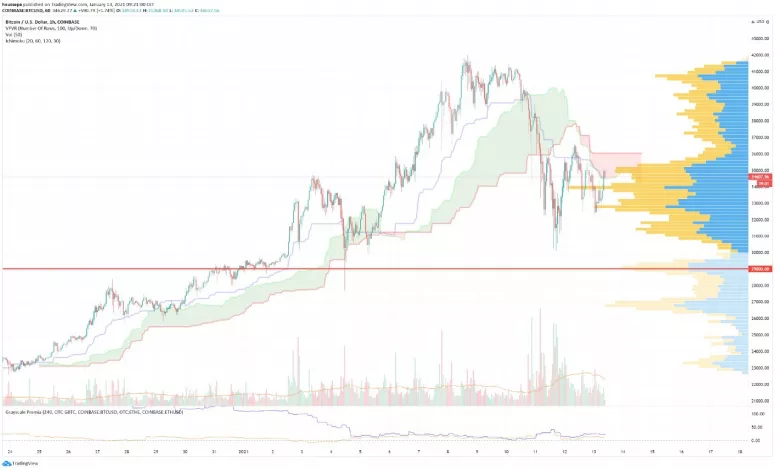
Bitcoin Ichimoku cloud – chart from TradingView, Patrick Heusser

The number of active addresses is ever increasing – this metric considers how many tokens are being transacted daily. With more investors the price of the underlying asset is sure to increase. Bitcoin active addresses figures are at an all-time-high at 1.34 million, seeing a 8.8% increase in a single day. 
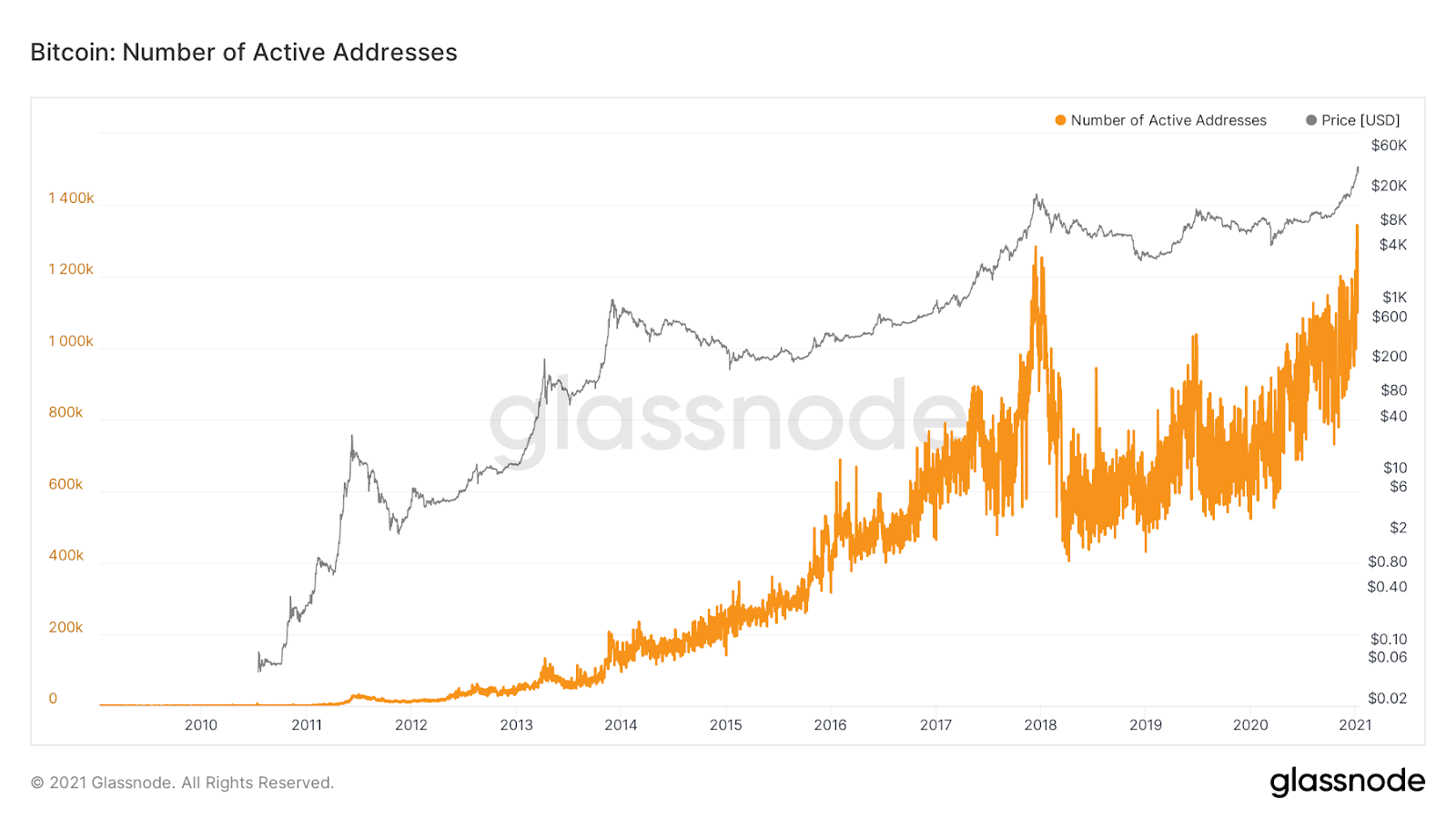
Similarly the number of active entries is at a high, showing investors are actively using Bitcoin’s blockchain. A massive 25% increase from the previous all-time high in 2017 can be witnessed. 

So is investing in crypto worth it?

Bitcoin is the strongest cryptocurrency out there, although all cryptos have high volatility. 

Cryptocurrencies avoid a centralised financial institution meaning they avoid inflation. If a government creates new money through a stimulus then inflation is sure to follow. Owning crypto is holding a stake in the value of a currency solely controlled by markets. It is more difficult to exploit or manipulate people who don’t rely on a central authority. 

However, crypto is not entirely immune from inflation. Mining crypto is comparable to printing money, though, the difference between the Federal Reserve and Bitcoin minors is that the miners are rewarded for their efforts. Halving means every one ‘block’ mined is cut in half every 210,000 blocks produced, which equates to a reduction every four years. There are around 2.5 million bitcoins left to mine, are the diminishing returns worth it? 

Why are cryptos unpopular with financial institutions?

Speculation has meant large pension funds and traditional investors are unlikely to hop-on the crypto bandwagon any time soon. Cryptocurrencies are not a suitable alternative to safe-haven assets and don’t help protect against risk. The high volatility and the fact that cryptos are not based on any underlying asset, only market pressures, makes them a high risk investment. Whilst more traditional investment institutions have kept away from the crypto market, hedge funds have been getting onboard due to the growth potential.

Mother of All Bubbles

The Bank of America’s chief investment strategist, Michael Hartnett, claims bitcoin is “the mother of all bubbles” concerning the recent rally. Bitcoin is an extremely crowded trade with the price being solely controlled by demand. In other words, investing in bitcoin or any other crypto for that matter is essentially putting all your eggs in one basket – even a small drop could see all your investment becoming worthless. 
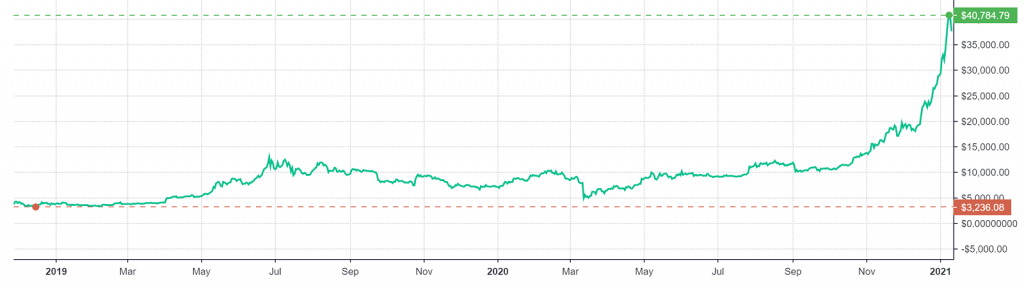
Bitcoin’s price from 2019 to present day from markets.Bitcoin.co

Bitcoin strikes as a clear frontrunner when comparing past bubbles. In the late 70’s gold saw a price surge of over 400% and nothing has gone above this level since. 

Cryptocurrency cannot provide a hedge for equity investments as the price of a stock tends to move with crypto trends. Crypto can see high volatility, on Monday Bitcoin traded at $10,000 below its peak of $42,000 just days before.  The steady drip of reputable investors has helped grow the bubble.
What about altcoins? 
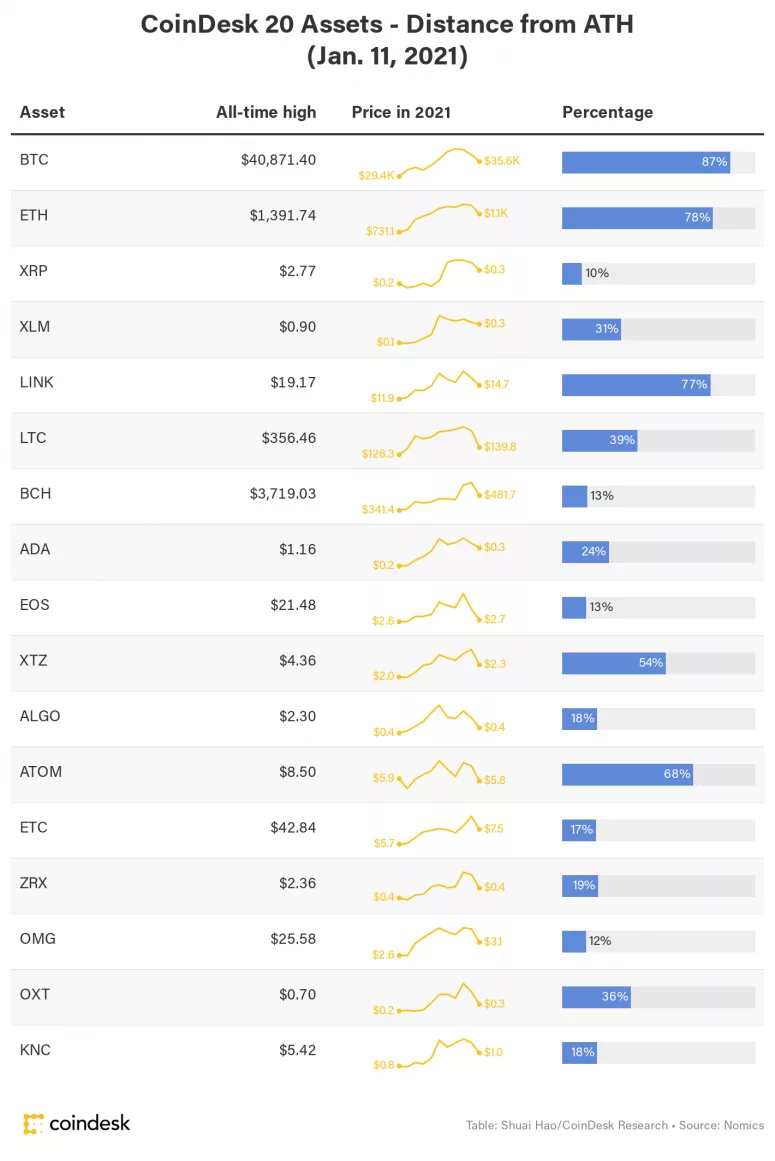
With Bitcoin pulling back from record highs, alternative cryptocurrencies are taking the spotlight. Bitcoin was 87% and ether was 78% from their all-time highs (ATH) on Jan 11th, where other coins were miles away from their ATH. This suggests there is a lot of potential for altcoins to climb higher, irrespective of bitcoin’s recent bull run. 

The high profile of the bitcoin bull run has encouraged newbies to join the crypto game due to FOMO. Some beginner investors see the low price tag of altcoins and invest due to their affordability. Altcoin movements follow those of bitcoin so are still risk-on.

What do you think will happen with crypto markets? Will we see a brief stabilisation before cryptos climb higher or will the bubble be popped? Keep up to date with the latest stock market news with BullBear.


Does working from home really save you money?

There are a lot of financial benefits that come to mind when you work from home rather than commuting to the office. With the average Brit saving £55 per week working from home, this gives you a monthly chunk to invest. But are you saving as much money as the average?

Working from home has many benefits, it saves you time, money and stress. But saving on transport fees, food and more can easily save upto £50 a day for high spenders. If you cut travel costs, socialising and other expenses that you would do working at an office you could easily save £500 a month! That is £500 a month that you can invest, to grow your wealth and invest in your future.

Working from home is the ‘new normal’ for nearly half (49%) of workers in the UK. The Office for National Statistics showed £157 billion was saved over the the first lockdown back in Spring 2021 with the average employee saving £495 a month working from home. 

Whilst some people are saving money due to physically not being able to spend it in shops due to various lockdowns, others have adopted a new frugality that comes with the uncertainty of a global pandemic. A survey by Hargeaves Lansdown found people are likely to stick with this shift with 32% of people saying they would go out less in future, 31% cutting back on impulse buying, 30% cutting on clothes and 15% reduced spending on food during the day. If you have accumulated from accidental savings, what could you do with the money? We recommend investing it

How are you saving money?

  1. Commuting
Photo by Life Of Pix on Pexels.com

This might be the most obvious expense you save on when shifting to working from home. If you drive to work you can save on fuel, maintenance and running costs. Or if you use public transport, not having to get the tube everyday or that occasional Uber really adds up! When your commute is less than 10m there is no need to splash out on transport. Some people have even sold their cars to save on that expense, after all, if you are not using it why pay for the running costs. 

  1. Wardrobe
Photo by Pixabay on Pexels.com

One of the best luxuries about working from home is the shift to more casual dress. Swapping that tie and shirt for a nice t-shirt might not seem like a money saving hack but believe me, it adds up! Think about the cost of smart shoes compared to your slippers or the dry-cleaning costs you will save on. People have also been more likely to sort-out their wardrobes during the pandemic auditing what you’ve already got meaning you are less likely to buy new items. Having retail outlets closed for a large portion of the pandemic has also helped curb the likelihood of spending on clothes. Oh, and not to mention how much you are saving by doing DIY haircuts. Looking good has never been less important. 

  1. Food
Photo by Tim Gouw on Pexels.com

When you have to commute to the office it is easy to pick up a nice coffee en route and to go to a cafe on your lunch break. £3 on a takeaway coffee, £8 on a bougie sandwich and that one or two beers after work at £6 a pop easily add up, but is also very easy to do. If you tot up your coffee spend alone, a daily coffee can cost you £3000 a year! But during the pandemic with everything shut, and their no temptation of being in close proximity to expensive food and drinks you can save a hell of a lot. Not only do you cut down on eating and drinking through the workday, with more and more people starting health kicks during the pandemic you can cut back on ready-meals, fast-food and takeaways that are typically high in salt and fats to slims your waist, but also trim your outgoing costs. 

  1. Childcare and dog walkers
Photo by Sharon McCutcheon on Pexels.com

A huge expense that parents experience is childcare for small children. If both parents work, childcare is almost unavoidable and is an expense that can really put a dent in earnings. Given the reduced childcare opportunities and requirement for home learning, looking after your own kids (whilst exhausting) can save you a lot of money! Not paying for professional childcare, like a nursery, after school club or nanny, whether it’s your decision or not, is a great way to save money and working from home means you have more chances to bond with your kids and be more involved in their learning. 

While not as expensive as childcare, dog walkers can cost a small fortune. Dog Walking or doggy daycare services can be expensive, especially if you are working long hours. But with the shift to working from home your furry friend can snuggle up to you for free! Although we can’t promise you’ll be as productive with a pet to distract you. 

  1. Tax breaks

New working from home tax breaks such as a government allowance and home office expenses can work wonders for your wallet. If your employer doesn’t pay for your new desk, chair or monitor you can claim tax relief through a P87 form. Anything that is a home office essential can fit into this scheme, including travelling for work (excluding commuting), upto a total of £2,500 a year.  Most workers in the UK can claim tax relief off the government! Anyone who has been made to work from home since April 2020 is eligible to claim tax relief off HMRC. 

Worked from home in the UK? You can claim £60 – 125 tax relief

In October, HMRC launched a new microservice meaning that anyone working from home, even for ONE DAY, could automatically get the whole year’s tax claim for working from home. This sounds too good to be true right? But after checking everything was legit, we found it really is worth it to claim this tax relief!

Martin Lewis, money-saving expert, contacted HMRC to receive this quote: “We recognise that the working-from-home situation is very fluid this year, so we’re accepting claims for the full year’s expenses. That includes even if people have only worked from home for some of the year, to avoid needing to contact us if you have to work from home again.” This essentially means the HMRC are willing to give away a year’s tax relief for people working from home as little as one day to save on processing costs. 

The tax relief covers increased costs for working from home, e.g. heating and electricity that wouldn’t usually be expected if you were out of your home and in the office. An average energy bill last year cost £1,254 equalling £3.50 a day, demonstrating the large cost of powering your home. But due to the shift in working from home due the coronavirus pandemic, a lot of Brits have been forced to work remotely. This tax relief scheme has always been around but has only seen a higher profile this year after the launch of the HMRCs microservice. 

So how do they put a price on working from home costs? Electricity and heating costs for working hours can be difficult to calculate, therefore the HMRC simplify this cost to £6 per week. If you think you have greater costs from working from home, you can claim more, but will have to provide evidence of bills – this might be more hassle than it is worth. 

Overall, you can receive between £62 and 124 a year depending on your tax rate. Those on the basic rate will receive £62/year and those on a higher tax rate can get £124 a year, calculated on the tax relief per week. The weekly breakdown surmounts to £1.20/week if you’re a basic-rate (20%) taxpayer, £2.40/week if you’re a higher-rate (40%) taxpayer, or £2.70/week if you’re an additional-rate taxpayer (45%). What makes this scheme great is that it is quick and easy to claim a one off payment. 

You can claim this tax relief through the government’s working-from-home microservice that will add the tax relief via your tax code in one lump sum.

What can you do with that extra £500 a month?

So if you take the average saving of UK workers per month when working from home versus working in an office, you can see a saving of £500 each month! We recommend you invest your money in a passive income stream that can help support your future. 

While it is hard to speculate, if you invested £500 a month just 10 years ago you can build a wealth of around £60,000, acknowledging inflation costs at 1 – 3% a year. If you choose the right investment vehicle you could yield a 8% rate of return, meaning investing your £500 each month can get you a total of £91,500 after 10 years. If you invested in a more risky option, like individual stocks, you could yield an investment much greater than 8%, although with more risk means a less predictable outcome. A safer option would be investing in an ETF, which weathers market volatility better and doesn’t run the risk of losing all your money if one company fails to perform. If you invested £500 a month in the S&P 500 for 10 years, you’d have around £120,000 today – that’s a 225% total return. If you want to keep things local, another popular ETF is the FTSE 100 which has the top 100 most highly capitalised blue-chip companies in the UK, investing in a low risk investment as these companies are all well-established. ETFs have the advantage of having low operating costs and being tax efficient compared to actively managed mutual funds. 

Working from home is here to stay! One study found remote employees work on average 1.4 days extra per month compared to those working in the office boosting productivity and saving on office costs.

What will you do with your extra money? Put it towards electricity and heating or invest it? Make your money work harder with BullBear

Should you buy or sell gold?

Gold prices are likely to have a bullish run this quarter, although prices are rocky right now.  The Democrats win in the Georgia Senate Runoff Elections supports the delivery of a fiscal stimulus said to push gold prices higher, although gold price is currently bearish. With gold in a current dip and overall prices set to increase, is it time to buy?

Gold is a metal commodity which is valued against the US dollar. Gold holds its value well, making it a safe haven for investors, although recently gold has been rockier than usual especially with the distraction of rising Bitcoin, investors are turning to crypto. Despite this, gold is a great hedge against inflation and typically follows opposite trends to stocks and bonds, meaning when typical markets decline, gold can increase. This means it is a great investment for uncertain times like these. 

Gold stocks and gold ETFs are the easiest way to invest in gold – there are two types of ETFs, those that track gold stocks such as VanEck Vectors Gold Miners ETF or a direct tracker of gold prices such as GLD ETF. It is good to be aware that investing in gold mining stocks such as Barrick Gold, Newmont and KirklandLake Gold finances gold miners and helps them make more profit. Increasing the price of gold inflates the bottom line to increase the profitability of miners, supporting the industry as a whole and feeding back profit into your investments. 

A record price of $2,070 was observed mid-2020 before falling back to $1,770 at the start of December. Will we see gold hitting the $2000 mark or declining over 2021? The jury is out.

Recent news

Gold prices sank below $1900 per ounce this week as Senate runoff elections and the riots in the US Capitol rose the dollar and Treasury yields higher. Despite this, gold is expected to continue its upward momentum as Democrats are set to release more fiscal help to revive the US economy. 

Following the Georgia elections on Tuesday the gold price rose to $1,950 with SPDR Gold Shares ETF seeing a 2% price jump. Now the Democrats have secured a win in both Georgia runoffs taking charge of the Senate, fiscal support can be given out encouraging gold prices to rise. The fiscal stimulus will push up the federal deficit and debt creating a nurturing environment for gold prices to creep up. 

Contrary to what was expected, the price drop in gold is largely accountable from Dow’s action to put a risk-on market alert for the historically safe-haven commodity. This sparked a swift sell-off as investors were nervous investing in gold no longer guaranteed profits. 

Fiscal policy is an important control on gold price. In December, the Federal Reserve policymakers suggested a shift to tighten policy was ahead also making gold a less attractive investment. Although they are holding loose policy for the next year so don’t be put off too quickly. 

While liquidity is flooding financial markets and central banks commit to keeping policies loose in the short term to increase price pressures to push gold higher, hopes for the end of the pandemic due to various vaccines being rolled out has dampened investors reliance on gold as a safe-haven commodity. 

Another factor that affects gold price is increased buying of physical gold in Asian markets this time of year. Consumer demand may pick up with the Chinese festival of the Lunar New Year coming up that has historically pushed up prices in January. Although with economic recession and the global pandemic limiting festivities, will we see the effect of this?

Buy or sell

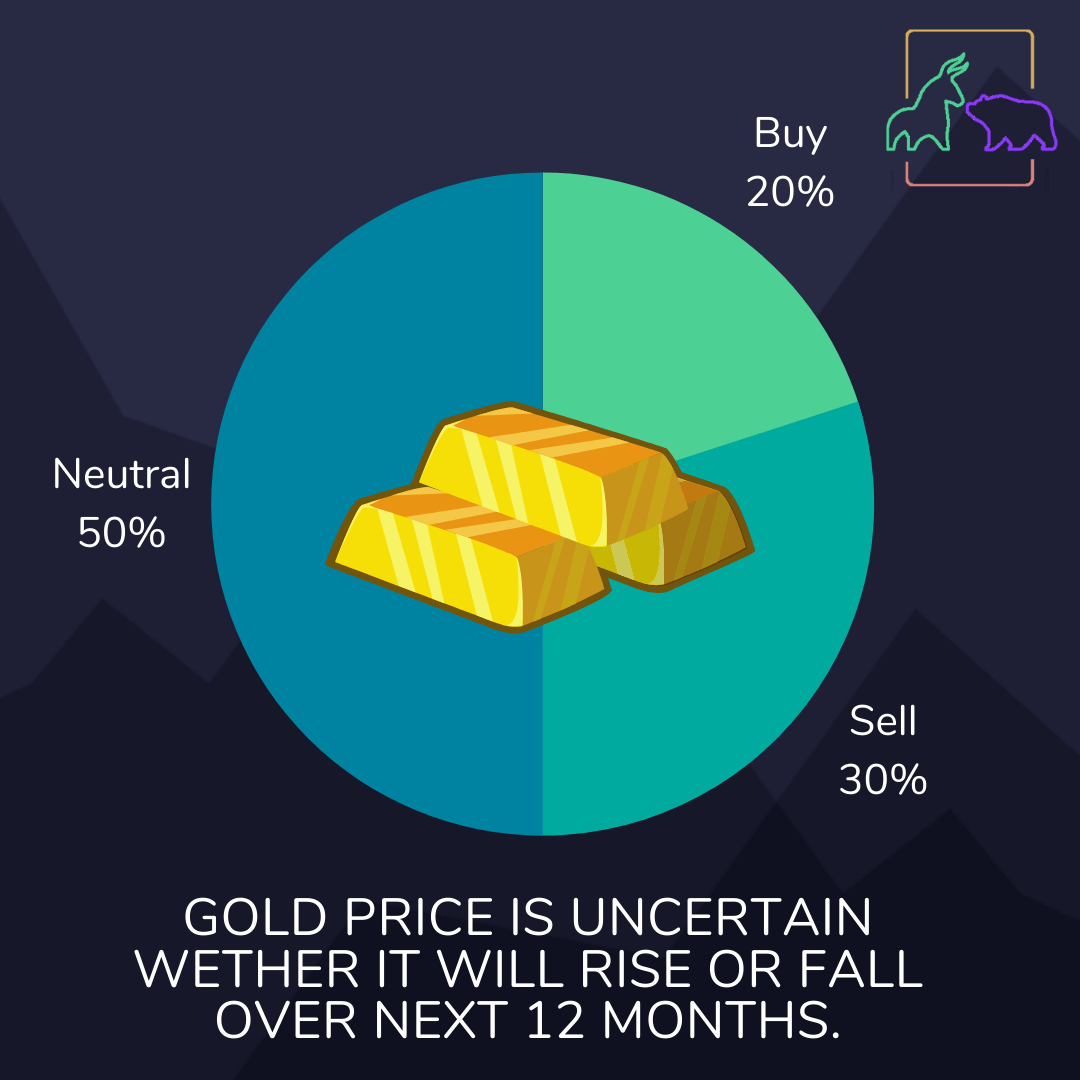
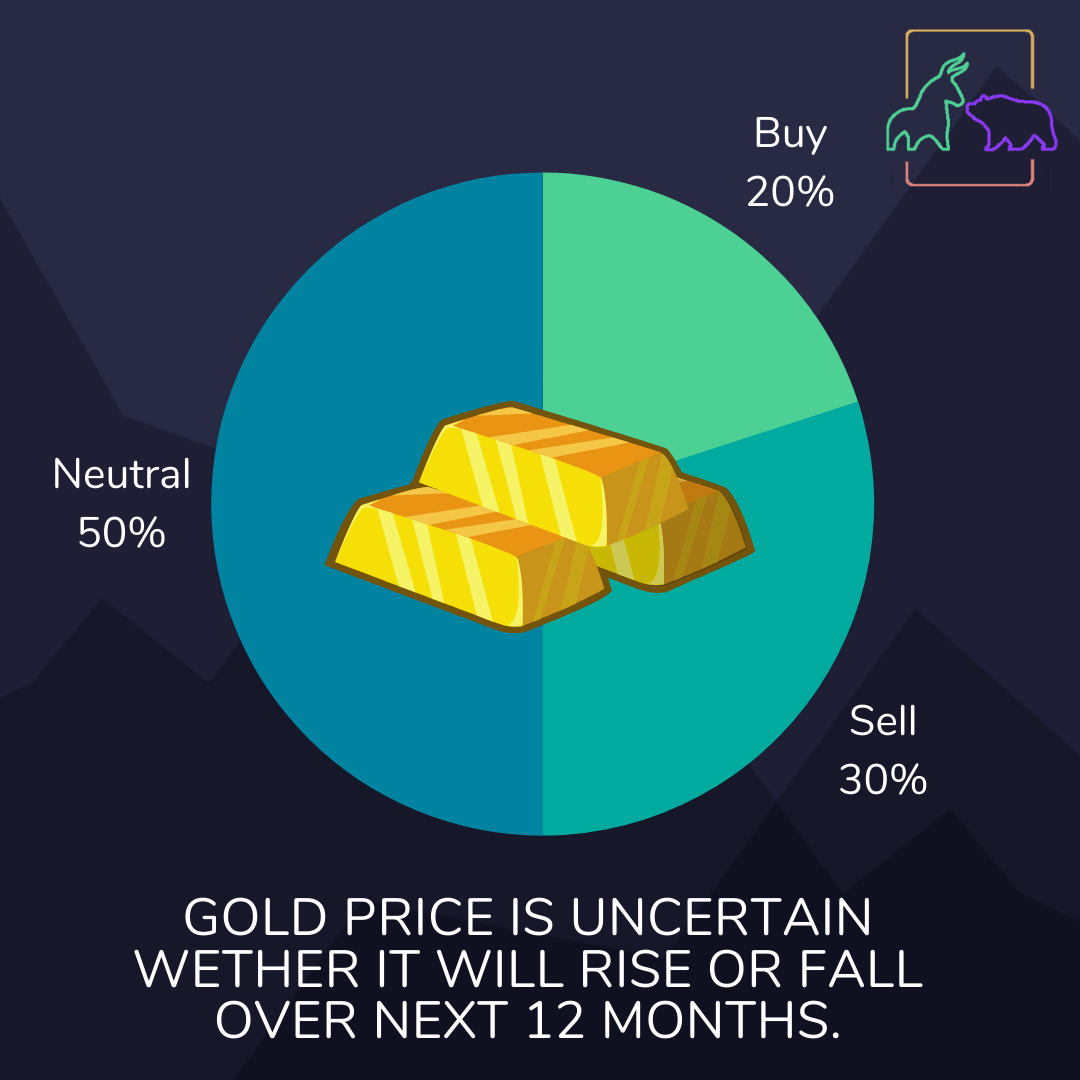
There is uncertainty whether you should buy or sell gold at the moment as price forecasts range from large gains to large losses. Moving averages recommend buying whereas technical indicators suggest selling. Whereas, markets show investors voting with their feet with a slight bias to buying gold. 

Considering the Democrats win hitting the news this Tuesday, Gold currently sees an overall buy at 50-60% of traders buying.  The strength in buying is currently weak but is increasing day-on-day. 

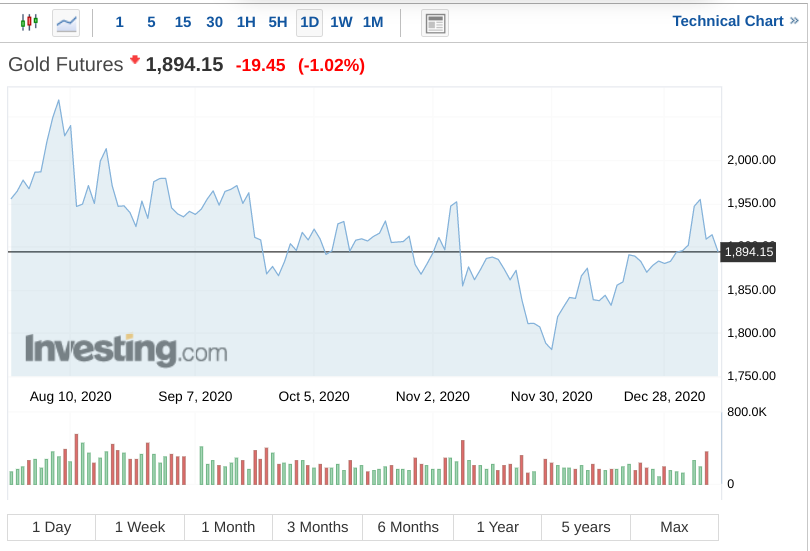
Long-term gold is a hedge against inflation making it a robust investment. Over 1 year, gold futures rose 20.5%. In August, Warren Buffett’s Berkshire Hathaway bought shares of gold miner Barrick Gold indicating the future is bright. However, there has been a fair amount of movement over the last few months and not all of it positive. 

Retail traders are mostly net long at almost 3 to 1. Although net-long traders have dropped by 7.2% since last week and those who are net-short are 41.4% higher than last week showing this pattern is reversing. This summary seems to suggest Gold prices may only fall short-term and see a reversal soon as more traders are starting to go net-long over the past few days. 

Chart from Investing.com

Price prediction

In mid-November Goldman Sachs chief commodity strategist, Jeff Currie predicted a $2,300 12-month target for gold. His bullish prediction was based on a forecast of rising inflation due to the poor economic state and doubts as to how the US dollar will perform in the current economic climate.

If we look at predictions just one month ago, there was an optimistic outlook for gold. Using a monthly chart, gold continues to rise following the ascending trend since summer 2019. XAU/USD is expected to rise above $2,000 early to mid-2021 using this prediction.

Forecast Poll 2021 from FXStreet

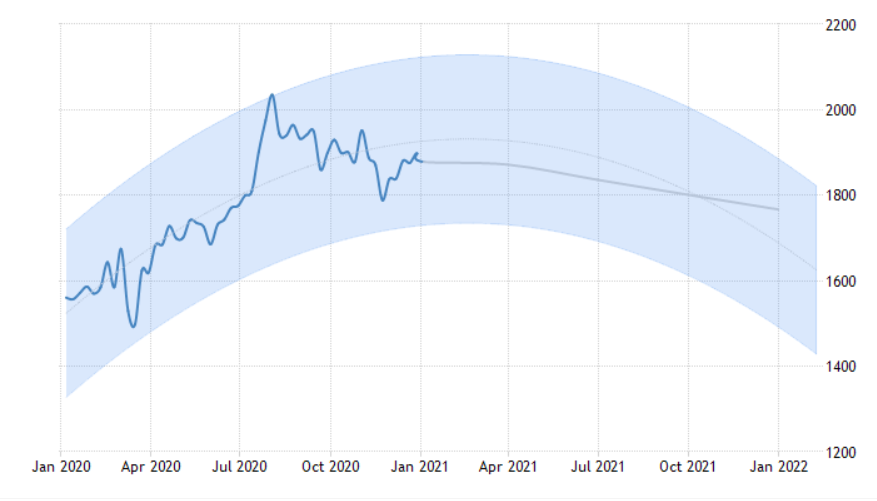
Since then, expert opinion has been more bleak with some predictions showing a price fall over the next 12 months. The future of gold is rocky with predictions over the next 12-months seeing a downtrend to $1767.

Graph from tradingeconomics.com

Over the short-term gold is likely to see a rise. Gold tends to benefit from times of greater volatility. The past few days saw gold volatility rise correlating to a rise in gold price. Rising gold volatility has almost always given a bullish outcome. 

The gold price outlook is bullish over the first quarter of 2021, although there is some dispute over this. We recommend you look at the graphs and resources provided to judge for yourself. 

Considering government deficits and interest rates staying low the economy is looking for growth post-pandemic. It might surprise you but gold is not the best performing commodity out there. Silver prices’ recent trends suggest that it may likely lead gold prices in the future. One thing that is more solid in terms of predictions is that gold will not likely be the frontrunner of growth with other metals such as silver, platinum, iron, nickel or copper likely to outpace gold prices this quarter. 

After a correction to the bullish trend, a fresh bullish impulse is expected to rise gold prices over this next year. Commitment to support the recovery of gold from governments and central banks could see gold push above the $2,000 mark. August and November saw highs setting a bull flag that was watched closely over December. Gold prices have passed the 38% Fibonacci retracements of the 2020 low high range of 1928 but have not yet passed the November high of 1965. If this level was broken a bullish run could be ahead, opening up the possibility of a move to $2000 or higher. The markets are likely to be jumpy until an influx of buyers bring up the price. Short-term however, there will likely to be some dips, opening up the chance to go short. 

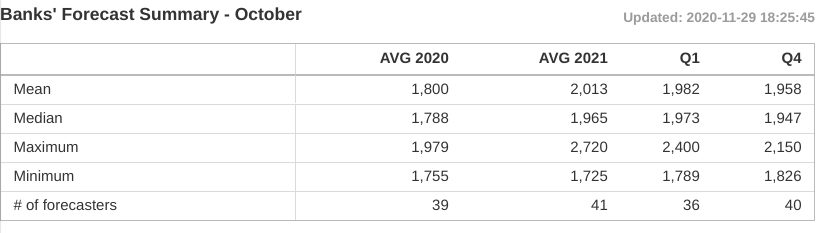
The table below is a good summary of what has been discussed. Gold’s future over the next 12-months is highly uncertain, possibly the most uncertain in recent history! Whether gold is a buy or sell is really open to opinion. 

Table from UK investing

Apply the same principles to buying gold as any stocks or ETFs meaning wait for the right buying point and do your research as to how stocks will perform. If you are uncertain whether to enter the gold markets, try our risk-free trading simulator app first! BullBear provides investing practice for free!

Trading 101: Alternative Investments

Alternative investments can open the door to diversifying your portfolio and building some great profit over the years. When you think of investing, you probably didn’t think of annuities, angel investing or even art! But alternative investments can protect against risk by mixing up what you invest in. 

Alternative investments have: a low correlation with traditional assets (stocks and bonds); low liquidity; and limited market data which can benefit investors if stock markets are rocky.

What are alternative investments?

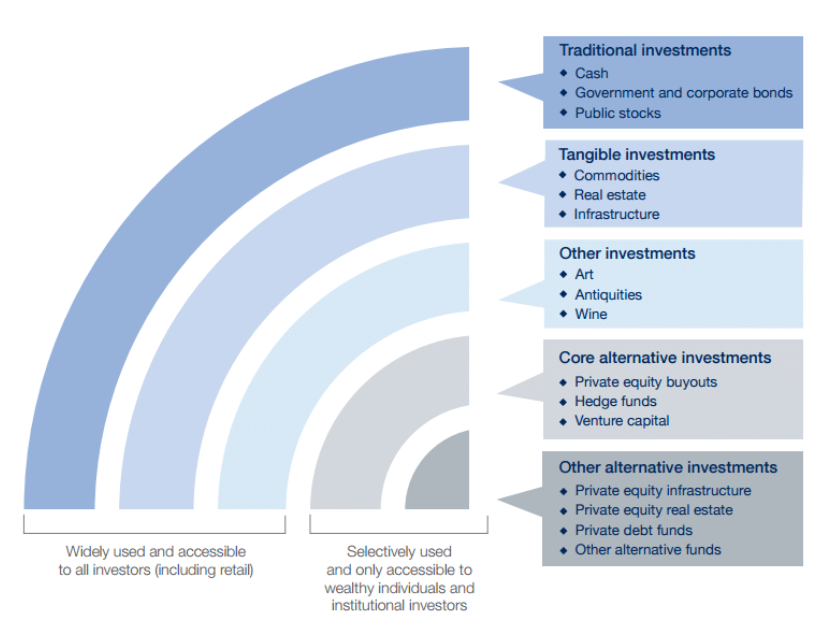
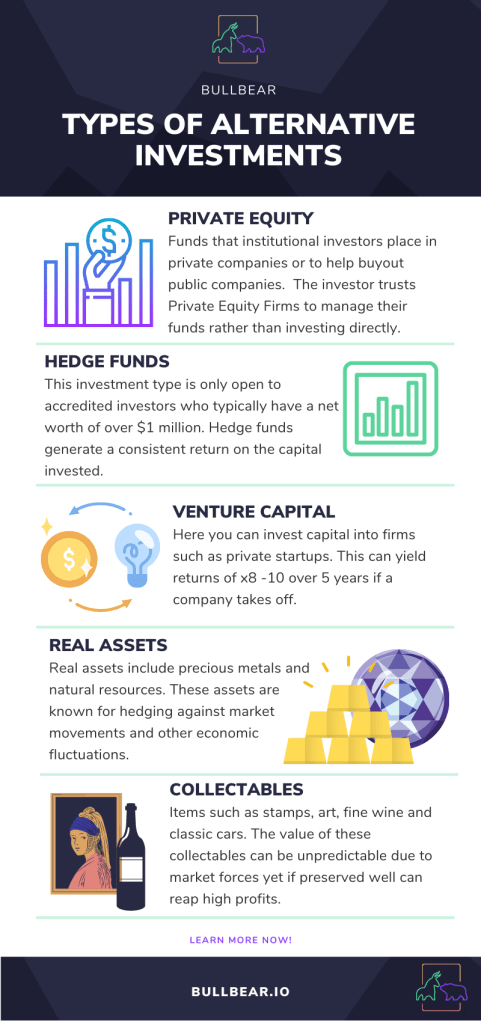
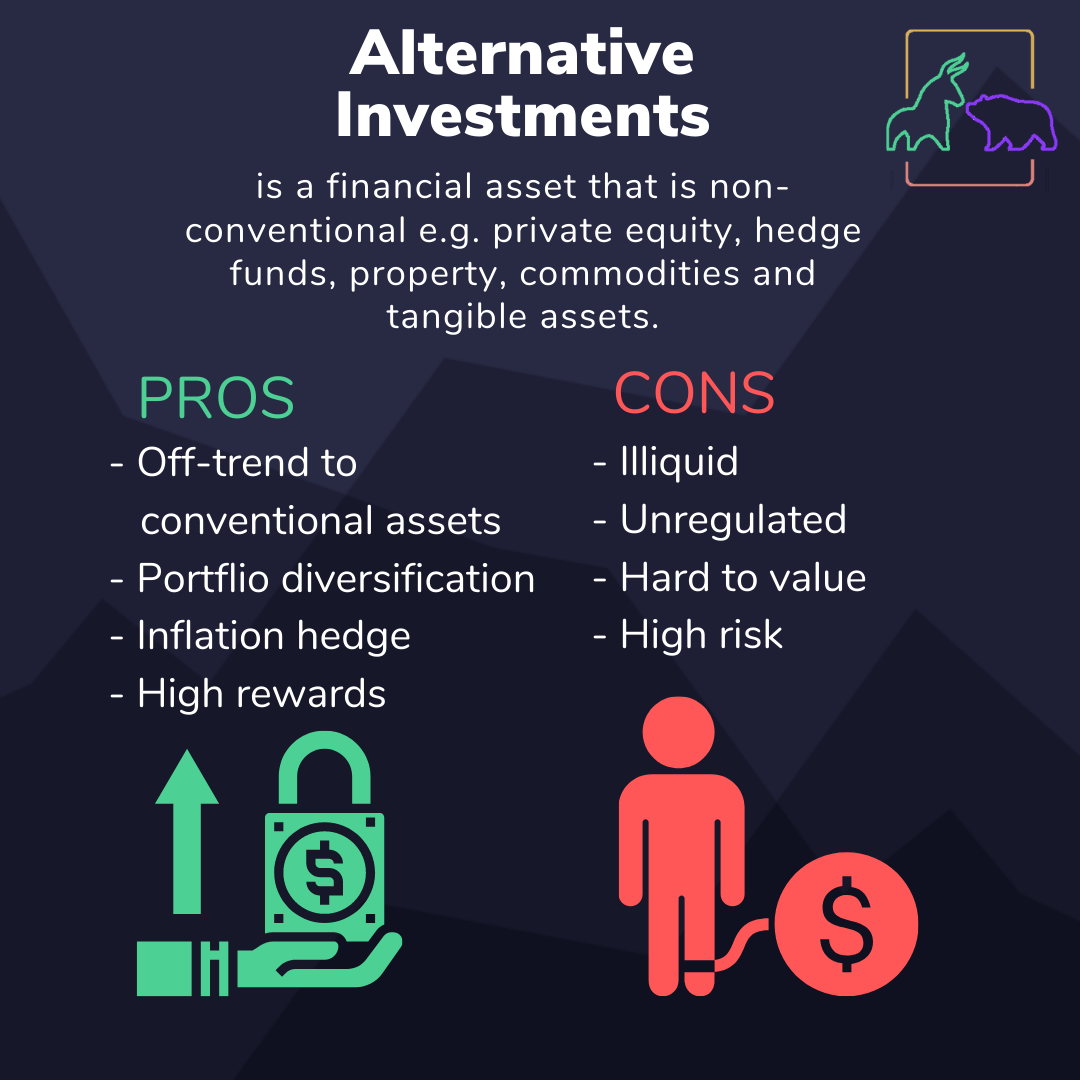
An alternative investment is a financial asset that is not conventional (stocks, bonds and cash). Usually, alternative investments are held by institutional investors due to the complexity of transactions making it easy to manage for you as the professionals do all the work. Alternative investments include private equity, hedge funds, property, commodities and other tangible assets, and tend to be mostly illiquid. Real estate, fine art, antiques and commodities fall under the class of alternative investments. 

Alternatives make use of the inefficiencies in the market with new and innovative strategies cropping up all the time. They tend to be less liquid and involve more complex strategies than typical investments. The signing up process is also more complex as alternative investments are typically non-registered securities. This makes alternative investments an easier and more effective strategy for investors with a qualified purchaser status. 

Alternative investments contain the same asset classes as typical investment portfolios including equities, fixed income and real assets. The aspect that makes alternative assets so different is the structures and strategies used. There are two types of alternative investments, the first are private assets such as private equity, private credit, infrastructure and property. The second type is hedge funds which operate in the public market. Alternatives offer some liquidity but not as much as conventional investments making it harder to withdraw your money in the short-term.

Hedge funds usually invest in listed securities whilst benefiting from the inefficiencies of traded markets. For example, by making use of a niche type of bond structure to generate more profit. These can then be sold when the investor likes due to some liquidity, although are usually invested in long-term. Private equity, however, makes you commit to a fund who then decides which opportunities to pick and choose over time. Private equity could be investing in anything from buildings to start-ups and is based in highly illiquid assets which only get the investor a return when the asset is sold. 

As alternative investments are out of the box, many people instantly disregard them thinking they cannot possibly turnover as much profit. But this popular opinion just isn’t true! Different alternative investments can yield different amounts which can be difficult to track.  Peer-to-peer lending can yield between 5-9% compared to the S&P 500’s growth of 10-11% a year. 

Research done by RBC Wealth Management found 72% of Americans believe that investors must be more flexible to different investment strategies. Diversifying your investments by allocating some funds to alternatives can make profits through different avenues that don’t rely on the performance of conventional markets.

Are alternative investments for me?

Although the popularity of alternative investments has increased over recent years and can build creative ways to profit from investments, it isn’t suited to everyone. 

You must consider why you are choosing to invest in alternatives to really pick out a specific goal and how you can achieve it. Also consider your risk appetite and how long you want to hold your investment for. Alternative investments are best for those investors who are okay with illiquidity and want to hold their investments long – term, for a decade or more. If you require liquidity for a retirement fund, moving or paying for education then now may not be the best time to invest, but if you have no big liquidity requirements and hold a large pot of money that isn’t working itself hard enough, then investing in alternatives would be great for you. You can think of liquidity as how easy the asset is to sell. A £800 vintage wine has much less demand than 100 shares of Facebook. This may also make it hard to value the item as without having a buyer and other similar items to compare the price, it is difficult to label up a price tag.

There are a few fallbacks which means alternative assets are not for everyone. Alternative investments tend to have high minimum investments compared to ETFs and have less public performance data for investors to analyse. Transaction costs, however, are much lower than conventional assets due to low turnover and less popularity. Something to watch out for with alternative investments is that they are unregulated by the Securities and Exchange Commission (SEC). If an asset is not overseen or regulated by the SEC or similar, it allows opportunist scammers and fraudsters to play. So be careful to do your due diligence and stick to an asset you have specialist knowledge on. 

Alternative investment strategy

Alternative investments have low correlation with conventional asset classes meaning they can move in opposite or completely separate ways to stock and bond markets. If you choose to invest in hard assets like property or gold, this provides a hedge against inflation which damages the purchasing power of money. This means investing in alternatives can protect against unpredictable inflation, making it a good option for long-term investing.

If you are signed up to a large institutional fund like a pension then usually a small part of the portfolio you hold (< 10%) can go towards alternative investments such as hedge funds. This could be an easy option for you to start investing in alternatives.

You could also invest in alt funds or liquid alts giving you the chance to invest in alternative asset types which are difficult and expensive to access as an individual. An added bonus is that they are SEC registered so your investments are protected!

What shall I invest in?

The most popular assets are commodities and real estate holdings followed by hedge funds at 26%. You should invest in an area you are comfortable with, so if you have a wealth of knowledge surrounding property, invest in property, but if your expertise lie in fine wines, invest in fine wines.

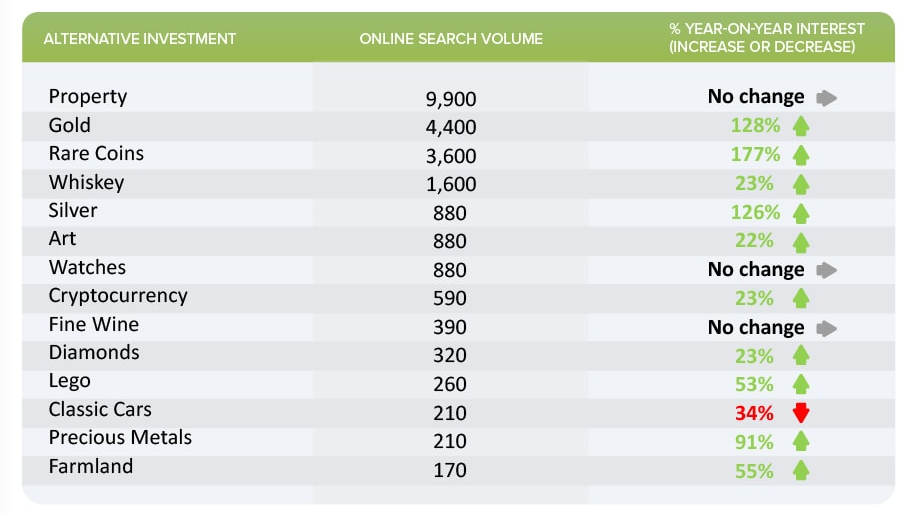
eToro have carried out a survey on what alternative investments are most widely searched for on the internet earlier this year by Brits. Not surprisingly property was the most popular asset, followed by gold and rare coins which both have grown a phenomenal amount of interest earlier this year. As people have more time to think about investing and want to make robust investments during the start of the COVID pandemic, alternatives have become more popular. Whilst property’s popularity has remained unchanged, interest in gold has increased 128% year-on-year and rare coins have gained a massive 177% interest year-on-year. The surge in interest in gold and precious metals can be explained by psychology around investing during covid times, with people opting for safe and robust options, where other investment options appear more risky as they are tied to economic performance.

Image from eToro

What alternatives shall I invest in for 2021?

  1. Peer-to-peer lending

Peer-to-peer lending is a service that offers loans for businesses, individuals or pretty much anything. You can loan money to borrowers who qualify under certain terms and then you can sit back and receive repayment each month with added interest. This avenue can provide returns on your investment higher than conventional investment. 

However, with everything, there is a risk. Borrowers who tend to use peer-to-peer lending often opt for this service as they are rejected from traditional loaning organisations such as banks, meaning they are more likely to default. A way to overcome this is by setting a risk level you are comfortable with by only accepting borrowers who meet the criteria you set, such as a certain credit rating.

  1. Gold

You may think investing in gold is backward but it is a strong investment with an interest increase of over 100% since the outbreak of coronavirus. Gold is a tangible inflation hedge, a liquid asset that can store a value long-term. Following the criteria of alternatives, gold is great for diversifying your investments as it has a low correlation with conventional investments such as stocks. There are many ways you can invest in gold from physically holding coins or bars to ETFs or gold accounts.

  1. Equity Crowdfunding

Equity crowdfunding involves you investing in someone else’s business. Startups that need money offer large portions of shares in return, allowing you to grow wealth much above typical market rates. The risk here is that the return depends on the success of the company and it is hard to tell which startups sink and which float when they are in their infancy.

If you want to diversify your portfolio, invest in alternatives to grow your money at a risk level you are comfortable with. For more tips and tricks, use BullBear

What is the January Effect?

It’s a new year! Typically January sees great rises in stock price that sets out the success of markets for the year ahead. Will we see markets rise this month, considering the heavy economic burden of the pandemic? Read on to understand more. 

What is the January Effect?

It is a seasonal phenomenon where stock prices increase. There are many explanations for it but it occurs mainly due to increased buying and then a price drop in December. This end of year price drop occurs when investors sell off to achieve year end capital gains taxes and use year end cash bonuses to start them off in the new year. There is a pattern of selling off stocks that carry heavy capital losses before the new year rolls in and then buying stocks with capital gains in January. Year end selling also encourages buyers who spot the low prices, knowing that the price fall is more about markets than poor company performance. With many buyers being active, this can help push prices up in January. Another contributor is investor psychology, with more people starting investing as a New Year’s resolution driving prices up. As more investors tend to be active right after New Years this can drive up stocks almost straight away!

January is bonus time and what do people tend to do with it? Invest it of course!

The January Effect, along with all seasonal effects demonstrate the markets are inefficient. It affects small caps the most as these are most liquid. In January, these asset classes outperformed the overall market that month, although the historical trend has been less obvious recently due to greater market adjustment. It has also become less prominent since in 2018 as people are using tax-sheltered retirement plans and therefore don’t need to sell at the year end for a tax loss. 

Although this doesn’t happen every year, since the 1920’s the S&P 500 rose 62% of the time in January at an average of 1.2%. January is also on record for seeing the biggest stock and bond inflows. Although this good chance of stock rises seems extraordinary, the truth is that in general the stock market rises 60% of all years following economic growth. But this does mean that seeing a stock market rise is a good indicator on how it will perform over that year, with a strong correlation between January increases and yearly increases found to date. 

What happened last year?

The S&P 500 rose 1.1% and the Dow Jones Industrial Average was up 1% already in January 2020, whereas NASDAQ rose 2.3%. With geopolitical tension and the start of the pandemic looming the markets rose much less than January of the previous year (2019), which saw 7.9% gains. Will this year see the start of recovery or the continuation of the recession induced by the pandemic? Only time can tell. With a weak economy over 2020 there isn’t great hope that we will see the January Effect happen. 

What should I do?

Ask yourself what strategy you follow. If you trade on the short-term then paying attention to the January Effect is essential to harness profits, whereas if you invest long-term, changing up your strategy for this seasonal phenomenon will leave you clueless and out of your depths.

If you’re a long-term player it is best to invest consistently. It can be tempted to hop on board with the January Effect but stick to your guns. Follow your predetermined strategy that lets you profit from your particular skills. If you usually invest regularly, it would be best to ignore this month-long phenomenon as you already ignore the small fluctuations in markets. Long-term investments can reliability yield on average 10% return, so don’t change what works for you!

The January Effect can see price rises across markets, irrespective of company performance making it the prime time to buy. Will we see this happen this year or will the pandemic led recession stop markets from rising? Keep up to date with the latest stock market news with BullBear.

2020: Year of the Bitcoin Boom

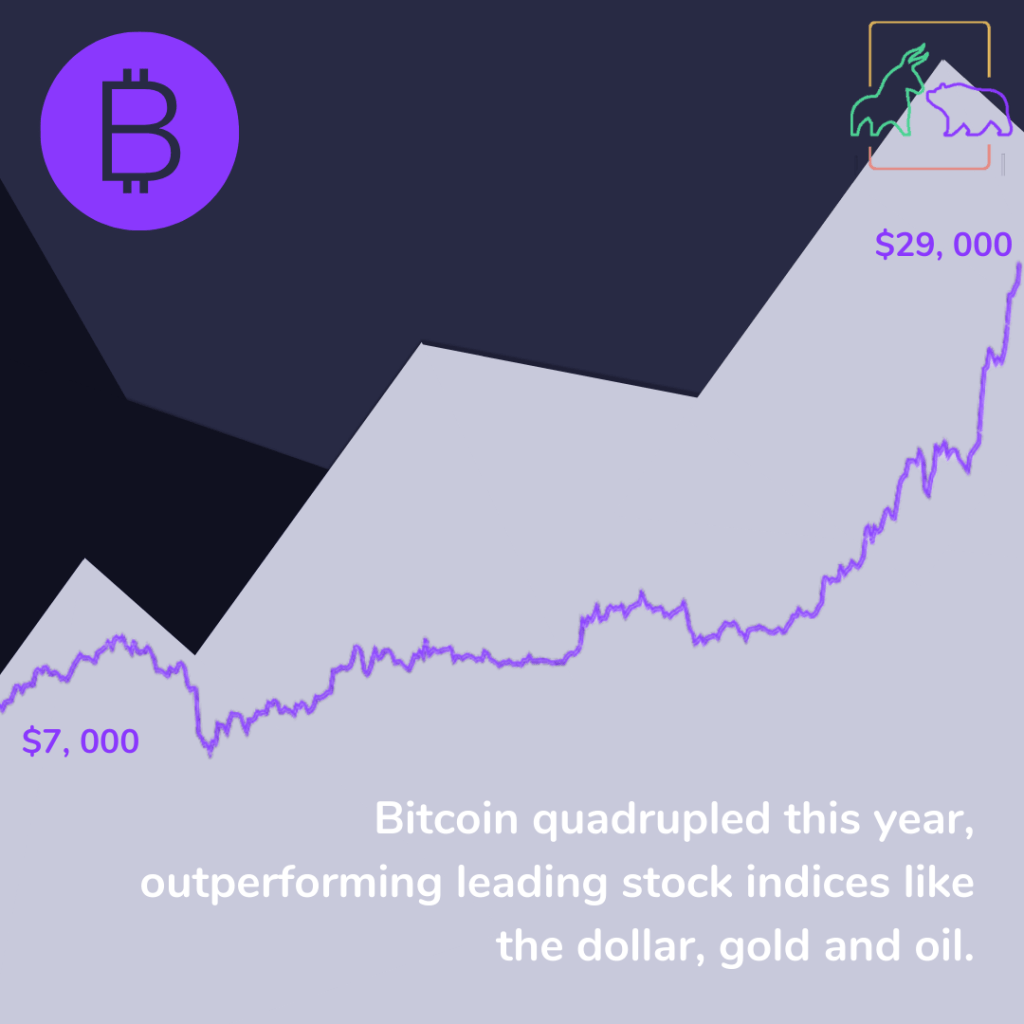
Bitcoin price quadruples over 2020, beating shares and gold. Bitcoin has gained 269% compared to the 45% for Nasdaq. But why this year? Despite arguments over the status of bitcoin, cryptocurrency remains hugely popular. The increased exposure and public understanding of crypto over the past few years has boosted demand for the limited supply sky-rocketing its price.

Bitcoin surged to $28.500 up 47% since the start of December and is on track for its biggest monthly gain since May 2019. The cryptocurrency has outperformed leading stock indices like the dollar, gold and oil.

Why is bitcoin so popular?

As other currencies, especially the US dollar having little growth or are declining, Bitcoin has attracted investment across the globe this year. Last week the US dollar dropped to its lowest level since April 2018 ahead of a strong economic recovery next year. 

Bitcoin has become a more mainstream method of payment with PayPal launching crypto trading late this year they now hold nearly 70% of all Bitcoin. Growing institutional investment has assisted with Bitcoin’s bullish run, supported by an increased interest from retail investors. After many high-profile traders like Paul Tudor Jones and Stanley Druckenmiller, and trading firms like Guggenheim, Fidelity adnd Blackrock supporting Bitcoin and its potential to replace gold, retail investors have followed. Some tech firms such as Square and MicroStrategy have even used their own balance sheets to buy Bitcoin. Wall Street is getting involved too with S&P Dow Jones Indices recently announcing plans to launch cryptocurrency indices next year.

Bitcoin has been increasingly popular throughout the global pandemic as investors look for new safe investments. With central banks likely to hike interest rates in 2021 as national debts rise over 100% GDP for the UK and US, investing in Bitcoin seems like a great idea. The cryptocurrency is a hedge against inflation as its supply is capped at 21million. The scarcity of Bitcoin will help hold its value as other currencies struggle. ‘Safe’ assets like government bonds and savings accounts are no longer immune to the effects of inflation, leading investors elsewhere. Furthermore, the possible debasement of conventional currencies following the central banks’ handling of the pandemic has diverted investors towards cryptos. 

Bitcoin may be a better investment than gold, as the traditionally safe investment’s price falls flat at $1,879 an ounce. Analysts predict Bitcoin will overtake gold as the most popular investment next year. Both assets are seen as safe alternative investments with a high growth potential. 

The risks of bitcoin 

There is still concern over regulatory issues for cryptocurrencies and with the highly volatile nature of bitcoin many wealth managers advise against investing in Bitcoin. Crypto prices are driven by speculative forces as there is no underlying basis to control price, meaning there is a high risk that you can lose capital if these forces were to swing the other way and Bitcoin were to take a serious dip. The only controller of the price of Bitcoin is demand and supply, as there is no underlying asset. Instead, wealth managers advise investing in real assets where the volatility is controlled, despite the attractiveness of crypto growth. 

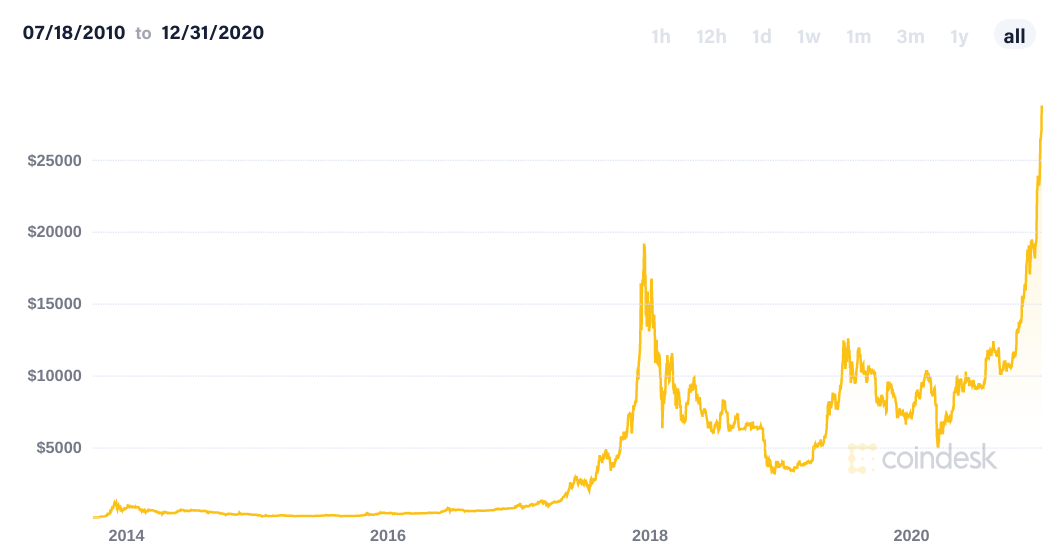
If you are someone driven by numbers, looking at the history books can teach us a lesson. The end of 2017 saw Bitcoin worth nearly $20, 000 with the end of 2018 seeing a close of just $3,000 after a massive fall. Although this appears scary, the rally this year has been driven by institutional buying rather than retail buying like this previous dip, giving some protection against a big drop. 

All time history of Bitcoin price from Coindesk

As 2020 comes to a close, we can admire the huge success of Bitcoin and the extent of its recent rally. Want to invest in Bitcoin but not sure if you have the skills? Try risk-free trading with BullBear

We have a deal | UK Stock Market News

UK shares skyrocket as the markets react to the Brexit deal being finalised. Since the announcement on Christmas Eve, the FTSE 100 and 250 were up about 2% reaching a nine month high. This great news was doubled with optimism towards the vaccine plan marking a possible end to the pandemic with the Oxford – AstraZeneca vaccine being approved for use in the UK this morning.

For a long time the Brexit deal has tested everyone’s nerves, but now the deal has been finalised, that uncertainty has washed away. UK share investors typically receive an annual return of 8% to 10% of their investment and now the odds will be even greater if you buy during the current recession.

Brexit deal boosts UK stocks and crashes banks

With the FTSE 100 closing the highest in almost 10 months things are looking up. Manufacturing was among the top risers with Halma up 4.8%, Diegeo up 4.4% and Smith & Nephew up 4.2%. Despite the good news about a Brexit trade deal being passed, banking shares fell across Europe with fears of the coronavirus pandemic having an ongoing effect on the global economy. Banks fell the greatest among all stocks with Lloyds suffering the greatest at -4%. This drop is also attributable to the lack of agreement on financial services in the Brexit deal. 

The Brexit agreement also saw UK citizens elated at the news that pension funds and investors on the London stock market are due to receive £145 billion in aid. The relief package is an outcome of the agreement between the UK and EU discussions on business support. With this new funding as part of the finalised Brexit deal, a rise in the UK stock markets was a sure thing. 

Vaccine Optimism

In other news, the vaccine has boosted shares and given optimism to the industries worst hit by the pandemic, with the travel company Intercontinental Hotels Group rising 4.2%. Vaccine development, AstraZeneca, has also done well seeing a 3.9% boost just after the Brexit deal was finalised last week.  With their vaccine approved for use in the UK this morning, there is likely to be a rally.  Back in 2012 their share prices were £30 and have been on the up and up ever since with highs of £96 this summer taking over Unilever in the FTSE 100. With a small blip in their records this year after buying Alexion at a 45% premium they have turned it back around with the recent approval of the cancer drug Lynparza and the coronavirus vaccine approved in the UK today. Analysts predict AstraZeneca will rise over 2021 but is unlikely to be the greatest riser in the FTSE 100 next year. Will you buy Astrazeneca shares before the vaccine is approved?

Stocks to buy

AstraZeneca is doing unbelievably well and it’s time to buy, just as the UK approves their coronavirus vaccine, AstraZeneca shares will rally.

Auto Trader is optimistic about its long-term prospects selling vehicles to UK markets in a post-Brexit world where other companies are restricted.

Burberry, with its popularity across the globe is going to have a good 2021, especially after barriers to the European market have been quashed with the Brexit deal finalised and huge growth in the Asian market driving further expansion.

Grainger, who are developing more and more affordable homes in the UK, are expected to sky-rocket as rent increases and more people opt to own homes. 

Reckitt Benckiser is the leading consumer goods company and their cleaning brands Dettol and Lysol are performing well considering the current concern for hygiene. Its third quarter results showed a like-for-like growth of 13.3% boosting prospects for the year to come.

Segro, a real estate investment trust who focuses on warehouses, has had strong performance this year with the phenomenal growth of online shopping. With this set to continue, investing now could add a low risk high reward stock to your portfolio.

Wizz Air shares will likely rise due to optimism that airlines can recover and evidence the flight paths they serve are growing in popularity with passenger growth at 10%.  It has proved it can survive this year so now may be the best opportunity to buy before the travel sector takes off. 

Overall, analysts predict markets will not see the full effects of the Brexit deal  until the pandemic has receded, allowing for economic recovery. The double-dip recession brought about by new virus strains have made investors hesitant yet investing in sturdy UK stocks while they are relatively low will reap profits when the economy bounces back. Stay up to date with the latest stock market news with BullBear.

Brexit borders and US stimulus | Latest stock market news

This year of breaking news is not over. Brexit borders and the US stimulus package delivery nods a bumpy road ahead for stock markets. Global stocks fell on Monday as the new coronavirus strain in the UK (which is up to 70% more transmissible) threatens global travel. Read on to find out more.

With over 3000 lorries waiting at the border between France and the UK due to take days to clear and a no-deal Brexit trade agreement looking likely, the UK stock markets have been fluctuating A LOT. Whereas in the US things are looking up with a generous stimulus package being announced over the weekend to help relieve the pandemic’s worst economic effects. 

Sterling recovers as Brexit borders reopen

Sterling rises as there is greater hope for a Brexit deal and the French border reopening today. Over the past week the pound has been more than wobbly, but with news of the UK set to regain control over the Brexit situation pushes it back up, regaining most of the ground lost. 

The UK currency has been volatile in the recent days after Boris Johnson (PM) announced a lockdown for the South East due to fears of a new strain of the coronavirus becoming more prevalent. Several countries have banned incoming flights from the UK as this new coronavirus strain is said to be more infectious by up to 70%. On Tuesday, EU negotiator Michel Barnier declared that most issues in the trade talks had been resolved with only fishing rights remaining. Furthermore, the UK-France border opened early this morning ending transport disruptions that have affected the UK markets. 

On Monday we saw the pound at just $1.32 when the trade blockage and no-deal Brexit news filtering through to the markets. Since then, the pound has risen 0.4% against the Euro to €1.10 today, standing at $1.50 compared to the dollar. 

We now see a shift to a bullish UK market as assets start to recover. Supposedly Forex traders have kept sterling fairly buoyant with the foresight that no formal Brexit deal will be reached by the end of the year, meaning passing a temporary agreement to continue tariff-free trade between the UK and Europe is the only way forward. However, with the challenge of managing the COVID pandemic and making a last-minute temporary trade arrangement that suits both parties needs, lends the fate of UK stocks to be highly uncertain. 

Stocks have been bumpy for the UK and Europe, although since the border reopening European stocks saw some recovery with the Stoxx 600 rising 0.5%. Meanwhile the UK’s FTSE 100 was set to fall lower this morning, reversing the modest rise it saw yesterday. 

The US stimulus passed injects $900 billion into the US economy

Despite the disrespect for Donald Trump in his last days of office, his objection against the US COVID stimulus deal has affected share prices over the past week. Trump flipped his opinion stating the agreed $900 billion stimulus package was a “disgrace” and too stingy despite his Republicans battling for months to lower the sum proposed by the Democrats. The stimulus package should assist the unemployed, struggling businesses and other areas of the economy that have been hit the hardest by the ongoing pandemic. This generous stimulus package will support Biden as he enters the office by giving him the tools needed to remedy the economy. 

So how much will the average American actually benefit from? With the new package around $600 will be given directly to the most struggling individuals, with people earning over $75,000 last year having a reduced allowance, and top earners (> $99,000) reaping no benefits at all. Those unemployed will continue to benefit from an extended federal unemployment allowance of upto $300 per week. With those of you thinking this is generous, Congress is extending its help to families with one parent not a citizen allowing these families to benefit from the $600 per person personal allowance which is applied to children too. See the table to understand a breakdown of the main expenditures including in the stimulus package.

BeneficiaryExpenditure
Business relief$275 billion
Education$82 billion
Transportation$45 billion
Food & Agriculture$26 billion
Assistance for renters$25 billion
Vaccine Distribution$20 billion
Entertainment Industry$15 billion
Childcare Assistance$10 billion
Border Security$1.4 billion
Unemployed$300 pp pw
Individuals$600 pp
Summary of the main beneficiaries of the US stimulus package.

In contrast to the clear UK City diary over the holiday period the US is set for an exciting afternoon as announcements for November’s personal finance and unemployment statistics are revealed. If there are greater unemployment rates than expected then the US economy will be held back for longer as reduced spending has evidenced that a recovery to the pandemic induced recession will be a long a rocky road. Also today are announcements of inventories of oil and gasoline that will provoke large movements in commodity prices. The Energy Administration is predicted to announce a fall in 3.2 million barrels of oil and 1.2 million barrels gasoline. 

This is a very risky time to trade with many market moves being jumpy so be careful where you place your money. If you are unsure, why not learn to invest risk-free with BullBear.

How to trade the Santa Claus Rally

December is a difficult month to trade as the year comes to an end and the holiday season sparks strange patterns in business and consumer spending. Most years in the lead up to Christmas and the start of January stock markets rally. But why does this happen and how can you take advantage of this?

The next few weeks will be deadly quiet in terms of trading as workers take holidays and less economic and earnings reports are released. On top of that, the stock and bond markets will close early on Christmas eve and Christmas day reducing the time you even can trade!

What is the Santa Claus Rally?

The Santa Claus Rally describes the increase in stock market prices that occurs at the end of December and beginning of January. There are many theories as to why this happens including: holiday bonuses, tax considerations, improved mood, and breaks from institutional investors. All things considered this increases consumer spending and drives up the prices of stocks with the added benefit of institutional investors taking leave to celebrate the holiday opening up investment opportunities for retail investors. 

Another reason that may drive up stock prices over this period is the anticipation of the January effect, where stock prices typically rise during January. More details on the January effect will come soon…

The Santa Claus Rally is a phenomenon that happens most but not all years. More than two-thirds of festive periods since the 1960s have seen a bullish market. The last five trading days of December and the first two trading days in January are typically when you can see the greatest rally with an average return found at 1.4% – which is fantastic news for those who are still actively trading over the holiday period.

Photo by Alexander Mils on Pexels.com

How should you trade the Santa Claus Rally?

To profit from cyclical trends such as the Santa Claus rally you can look into historical data to identify patterns. However, as some price movement is predictable from analysing these patterns the amount of risk and reward tends to reduce. You should bear this in mind when deciding on where to place your stop losses to ensure your expectations are realistic. 

You also must have the know-how to trade well on short time frames as this rally is over in a couple weeks. Trade to your strengths, remember, you shouldnt deviate from your trading plan because of an event like this, instead you should judge how you can include the Santa Claus Rally into your usual trading habits to reap the benefits. 

What shall I invest in?

Considering the current news of the generous US stimulus going through it’d be best to focus on US stocks over the next few weeks! 

Photo by Snapwire on Pexels.com

The most obvious and lucrative sector that does well over the holiday period is retailers. This year, considering the coronavirus pandemic and associated restrictions, focus on investing in online shops and megastores. For the US this could include Walmart, Target, TJX and Best Buy as these companies have proved they can stay in profits despite the difficulties going on. 

Some non-retail stocks that should also be successful are UPS and Starbucks for their own roles during the holiday season. Holiday themed drinks and ordering and sending gifts to loved ones is one thing corona has not taken from us this year. A little known fact about UPS is their role in assisting with vaccine distribution over the US, which will boost activity and surely drive up share prices. 

If you like to play it safe then investing in the S&P 500 is a good bet as records show that the index rises EVERY time in December when there is a year-to-date gain of 10 – 15% and no sign of a bear market. These factors assure us the S&P 500 will rise over December into the new year. However, there will be something different this year with the addition of Tesla to the S&P 500 today. Tesla is typically volatile, yet many are seeing their recent rises as an indicator of the broader market. Trading the index this week will be risky, but it might just pay off!

A saying you hear a lot at this time of year on Wall Street is: “if Santa fails to call, bears may come to Broad & Wall.” The seasonal gift of the Santa Claus Rally doesn’t happen every year, but considering what a difficult year it has been, let’s hope that Santa pays us a little visit. Keep up to date with the latest news by following BullBear or visiting our website.

Trading 101: The best time to trade Forex

With Forex markets open almost all the time how can you decide when it is best to trade? The most lucrative times are those where different financial centres overlap as more active traders increase liquidity and therefore profit. Read on to understand when are the best times to trade Forex.

Forex traders should be aware the markets are open 24 hours a day, 5 days a week making it convenient to trade at any time. But you cannot trade every hour the markets are open as you’d be exhausted! So how do you select which period is most lucrative?

The Forex market is open so long as it covers the regular business hours of four different parts of the world for their respective time zones. Liquidity increases when most traders are active in the market, increasing bids and pushing turnovers, so the most popular times are the most lucrative. 

Different Markets

There are four main sessions of the Forex market: London, New York, Sydney and Tokyo. 

London: 7am – 4PM GMT

The London Forex market serves the UK and Europe and is the largest currency market in the world. This market aligns with European trade and often sets trends that technical traders can track to get ahead in other markets. For example, analysing how the London market performs informs what trends are likely to occur during New York market trading hours.

New York: 12PM – 9PM GMT

New York, US is the second largest foreign exchange market. Movements in the NYSE can severely affect the dollar as mergers and acquisitions are finalised during trading hours.

Tokyo: 11PM – 8AM GMT

Tokyo, Japan is the first market to open in Asia and handles most Asian trading, followed by Hong Kong and Singapore. The USD/JPY currency pair sees a lot of movement when the Tokyo market is open due to the Bank of Japan’s influence on the market.

Sydney: 10AM – 7AM GMT

Although Sydney, Australia is the smallest of the great Forex markets it is particularly good to trade when they open on Monday morning (Aus time) as all the movement in other markets on Friday needs to be caught up on considering Sydney market closes the earliest at the end of the previous week.

Best time of day

Time ZoneEDT (April –
October)
EST (October –
April)
GMT
Sydney Open
Sydney Close
6:00 PM
3:00 AM
4:00 PM
1:00 AM
10:00 PM
7:00 AM
Tokyo Open
Tokyo Close
7:00 PM
4:00 AM
6:00 PM
3:00 AM
11:00 PM
8:00 AM
London Open
London Close
3:00 AM
12:00 PM
3:00 AM
12:00 PM
7:00 AM
4:00 PM
New York Open
New York Close
8:00 AM
5:00 PM
8:00 AM
5:00 PM
12:00 PM
9:00 PM
Forex market trading hours in different time zones.

The busiest times are when sessions overlap as traders can then buy from multiple continents. The London market is the most active as it encaptures the EU, then follows the US market and then Tokyo. When the London and US markets overlap (peak at  2PM GMT or 10AM EST) is the best time to trade as the London market is closing and the US market is opening up. This overlapping period creates big swings in currency prices giving the best opportunity for profit. 

Liquidity is at an optimum level around midday to 4PM GMT as the two largest financial centres are active (London and New York). Here you will see the biggest moves in the Forex market due to news reports in Northern America and late news updates from Europe. There is a point at the end of the overlap however, that might be better to avoid. When European traders start closing positions at the end of their day, there can be some big jumps in Europe-based and US currency pairs.

Best day of the week

The greatest price movement in the four main currency pairs (EUR/USD, GBP/USD, USD/JPY, USD/CHF) are in the mid week. Tuesdays and Wednesdays are the best days to trade Forex  because there is higher volatility. Additionally, Fridays before 12AM (GMT) are extremely busy, but after midday try to avoid trading Forex as this is when the major traders start closing positions ahead of the weekend. 

The worst time to trade Forex is when markets are unpredictable. It is best to avoid Friday afternoon, weekends, closing sessions, bank holidays or when major economic reports are released. 

If you want to trade Forex, try practising with the BullBear app to get the hang of it.